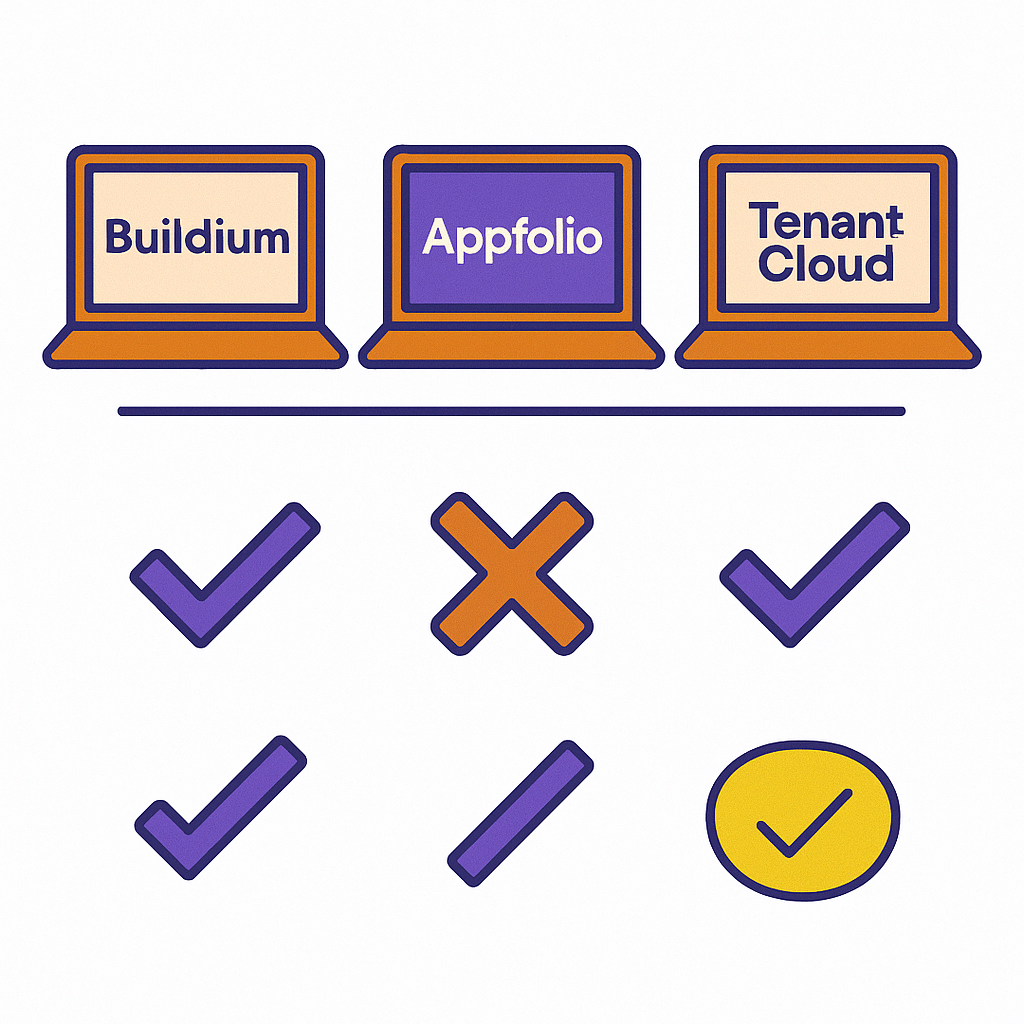
What each platform is — target users & positioning
Buildium
- Geared toward small to mid-sized landlords or property managers, including residential rentals, HOAs, and community associations.
- Offers predictable flat-monthly pricing (rather than per-unit) which makes it attractive when managing a smaller number of units.
- Good for portfolios that may be small to mid-size, or growing gradually.
AppFolio Property Manager
- Designed for medium to large portfolios, and even enterprise-scale property management.
- Supports residential, multifamily, commercial, community associations — so more versatile for mixed or large portfolios.
- Uses a per-unit pricing model, often more cost-effective when managing many units.
TenantCloud
- Marketed toward landlords/property managers with smaller portfolios or those who want a simpler, budget-friendly solution.
- Offers a free-tier (or low-cost tiers) and “flat-rate” pricing rather than per-unit (depending on plan), making it accessible for small portfolios or DIY landlords.
- Good for those who need core property-management features without high costs or enterprise complexity.
Core Features: What they each do well (and limitations)
Buildium — solid baseline functionality, easy to get started
Strengths:
- Provides a comprehensive set of features: online rent collection, maintenance tracking, tenant and owner portals, accounting & reporting.
- Offers a free marketing website, listing syndication, online applications, tenant screening, online lease signing — from application to lease completion.
- Include maintenance and repair management (ticketing + tracking) + a Resident Center (tenant-facing portal + mobile app) for payments, requests, communication.
- Predictable flat-fee pricing makes budgeting easier, especially for smaller portfolios.
- Amenities like integration with third-party “Marketplace” apps and an Open API for customization and workflows.
Limitations:
- Not always ideal for large or enterprise-scale operations. Some reviews state it’s “not ideal for enterprise portfolios.”
- Reporting customization is somewhat limited.
- Some advanced features (e.g. eSignatures, possibly bank-account setup) may be add-ons depending on the plan.
AppFolio — robust, scalable, built for complexity and growth
Strengths:
- Provides full-featured property accounting, customizable dashboards, automatic bank reconciliation, owner statements, income and cash-flow reports.
- Strong leasing tools: online applications, tenant screening, e-leases, lease renewals, bulk pricing, AI-assisted leasing, self-guided / 3D tours, lease-management dashboards.
- Maintenance and work-order management, inspection tools, unit turn services — useful for high-volume or mixed-use portfolios.
- Owner and tenant portals, communication tools, and mobile access — support for remote and mobile management.
- Highly scalable; per-unit pricing becomes more cost-effective for larger portfolios, and advanced plans add CRM, custom fields, API access and more, making it suitable for more complex operations.
Limitations/Considerations:
- Requires a minimum portfolio size (commonly 50 units and a minimum fee), which may be prohibitive for small landlords.
- Higher per-unit cost compared to flat-fee competitors — may be expensive if you have fewer units or don’t need full enterprise features.
- Because of the many features and customizability, might have a steeper learning curve and more complexity than simpler tools.
TenantCloud — budget-friendly, simple, for smaller portfolios or DIY landlords
Strengths:
- Very affordable compared to many competitors: plans starting at about $18/month, even with unlimited units.
- Covers core functionality: online rent collection, maintenance requests, rental listings and applications, basic accounting, tenant portals, leases, and communication.
- Suitable for “small to medium” landlords or those managing a few units — easier to onboard and less complicated than enterprise-grade systems.
- Flat-rate pricing + flexibility (unlimited units on many plans) helps for small-scale landlords scaling up gradually.
Limitations:
- Accounting and financial reporting are more basic compared to Buildium or AppFolio — might be insufficient for complex portfolios or heavy accounting needs.
- Some users report limited integrations (e.g. with other accounting software), and less robust CRM or automation options.
- The “Starter” plan, while very cheap, may be too limited for more than a small handful of properties — Growth or Pro plans are likely needed as you scale.
- Some complaints about payment processing delays or issues, and reporting or lease-builder tools being “clunky.”
Pricing & Cost Structure — compare headline numbers
| Software | Entry / Typical Pricing Model | Suitable Portfolio Size / Minimum Requirements |
|---|---|---|
| Buildium | Plans from ~ US$58–62 / month (flat fee) | Good for small to mid-sized portfolios (no strict “min units” requirement) |
| AppFolio | Per-unit pricing: e.g. Core ~ US$1.40–1.49 per unit/mo, with minimum ~50 units / min monthly spend ~$298–$300. | Best if you have 50+ units — scales up efficiently for medium to large portfolios |
| TenantCloud | Flat-rate tiers: Starter ~$18/mo, Growth ~$32–35/mo, Pro ~$55–60/mo (unlimited units in many cases) | Very accessible for small landlords or portfolios — suitable for small to medium numbers of units |
(Prices in USD — depending on exchange rates and your location, actual costs might differ.)
When One Might Be Better Than the Others — Use-Case Scenarios
- If you manage a small or modest number of rental units (e.g. under ~50–75), or just starting out as a landlord: TenantCloud or Buildium tend to be better fits. TenantCloud gives you a low-cost, lightweight, minimum-commitment way to handle listings, rent collection, maintenance etc, while Buildium gives a more robust baseline with better accounting and owner/tenant portals.
- If you expect growth (scaling up units over time) but want predictable costs: Buildium’s flat-fee model helps you budget easily.
- If you manage a medium-to-large portfolio (50+, especially 100+ units), or have mixed/multi-property types (multifamily, commercial, community associations): AppFolio tends to offer the most scalable, powerful, and comprehensive feature set, especially around leasing, maintenance, accounting, and owner/tenant workflows.
- If you prioritize simplicity, low cost, and don’t need advanced enterprise-like features: TenantCloud is a good “get started” or “lean” platform.
- If you need automation, reporting, customizable workflows, and plan to scale significantly: AppFolio has the most advanced tooling and flexibility, but comes at a higher cost and complexity.
What Reviews & Real Users Say — Strengths & Common Complaints
Buildium
- Users and reviewers appreciate its balance of features and affordability especially for smaller portfolios.
- Strong tenant and owner portals, rent tracking, online payments, and maintenance portals get frequent praise.
- Common complaints: some users find reporting limited or cumbersome, payment processing and accounting may require manual work in complex scenarios.
- Not ideal for those needing enterprise-level scalability.
AppFolio
- Users highlight its comprehensive capabilities — robust accounting, self-service portals, lease & marketing automation, maintenance/work-order management — especially for larger or mixed portfolios.
- Particularly valued for time-savings, efficiency, and centralized control over many units and tasks.
- Criticisms: Higher cost, per-unit pricing can get expensive; possible steep learning curve; some users report issues with payment processing or account configuration for complex setups.
TenantCloud
- Well regarded for affordability and essential features — many landlords with small portfolios find it sufficient for rent collection, maintenance, and basic accounting.
- The user interface and ease-of-use is often praised, especially for landlords without a large team.
- Weaknesses: limited accounting and financial reporting capabilities, less advanced automation or integrations, sometimes “clunky” lease-building or renewal features; some users report bugs or limitations with payment processing or support reliability.
Also, from user-shared community feedback (on Reddit and similar):
“Just switched from Buildium to AppFolio … buildium was easier to use.” — user noting Buildium’s simplicity but AppFolio’s strength for handling multiple entities. Reddit+1
Another user: “Using TenantCloud … I really like Auto Pay and Maintenance Management but I’d like them to improve the reports… the app is buggy.” Reddit+1
And:
“TenantCloud … now they charge ACH / payment fees — tenants don’t like it.” Reddit+1
So in practice, some landlords find TenantCloud good for small portfolios — but less reliable if you value smooth cash-flow, scalable reporting, or legal compliance (e-signatures, leases).
Summary — Which software fits which landlord/manager profile
- ✅ Choose TenantCloud if you are a smaller landlord or manage a limited number of units, want a budget-friendly solution with basic features (rent collection, maintenance, leasing) and value low cost and simplicity.
- ✅ Choose Buildium if you manage a small to mid-size portfolio and want a balanced, all-around property management solution — good accounting, tenant/owner portals, maintenance tracking — without per-unit pricing pressures.
- ✅ Choose AppFolio Property Manager if you operate a larger or growing portfolio (50+ units, maybe 100+ or more), especially with mixed property types, and need advanced leasing, automation, maintenance, accounting, and scalability.
Comments