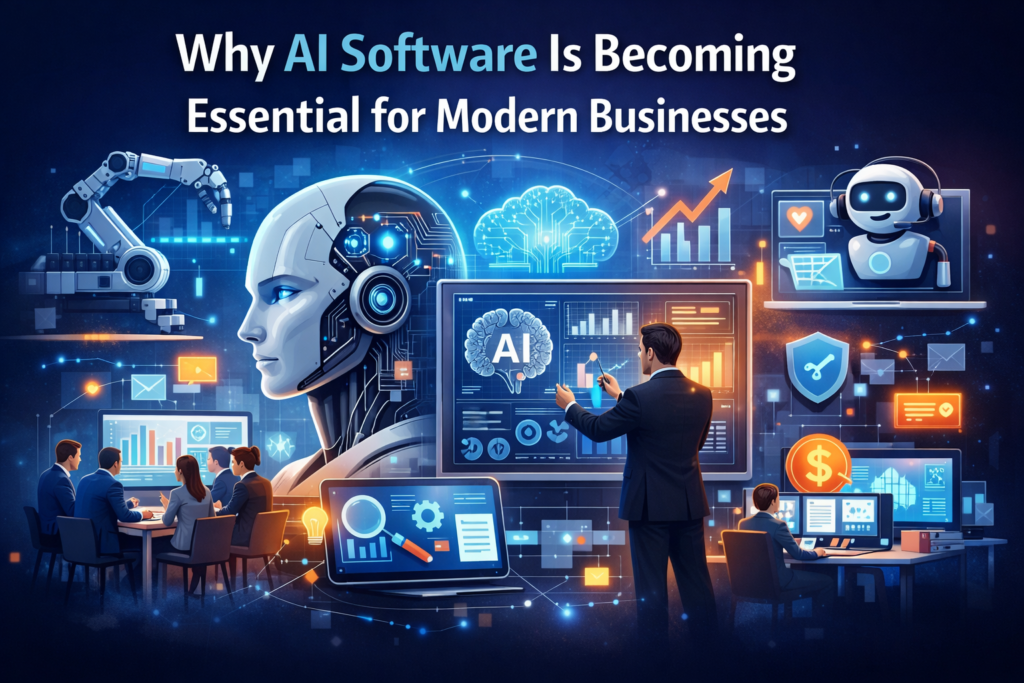
Artificial intelligence is no longer an emerging technology reserved for large enterprises or experimental teams. Today, AI software is becoming a foundational component of how modern businesses operate, compete, and scale. Organizations across industries are adopting AI tools to automate processes, analyze data more effectively, and improve customer experiences—driven by measurable productivity gains and competitive pressure.
Businesses evaluating AI adoption increasingly turn to curated platforms and AI software directories to compare tools, features, and use cases before implementation. Platforms that organize and list AI solutions by category help decision-makers reduce risk and accelerate adoption.
AI adoption is accelerating across industries
Independent research consistently shows that AI usage has moved into the mainstream. Global enterprise surveys from McKinsey indicate that more than half of organizations already use AI in at least one core business function, with adoption continuing to rise year over year. Gartner further projects that by 2026, the majority of enterprises will have generative AI systems running in production environments.
This rapid adoption is driven by practical outcomes rather than experimentation. Businesses are implementing AI where it delivers measurable value—operations, analytics, marketing, and customer support.
To navigate this expanding ecosystem, many companies rely on structured platforms such as AI software listings to identify tools aligned with their operational needs and budget constraints. Curated directories like AI software listings help businesses compare solutions without relying solely on vendor marketing claims.
Operational efficiency is a primary driver
One of the strongest arguments for AI adoption is efficiency. AI software automates repetitive, time-intensive tasks such as data entry, ticket classification, forecasting, and reporting.
McKinsey research shows that AI-powered automation can significantly reduce operational costs in functions like customer service, supply chain planning, and finance. IBM has also reported that organizations using AI for workflow automation experience faster execution times and reduced human error.
For modern businesses, especially small and mid-sized companies, AI tools provide leverage—allowing lean teams to operate at a scale that previously required much larger workforces.
Data-driven decision-making requires AI
Modern businesses generate massive volumes of data, but raw data alone does not create competitive advantage. AI software enables organizations to extract insights, detect patterns, and predict outcomes at a speed and scale that manual analysis cannot match.
Harvard Business Review has repeatedly highlighted the role of AI in improving strategic decision-making, particularly through predictive analytics and machine learning models. These systems help leaders anticipate demand, identify risks, and optimize resource allocation.
As the number of AI tools grows, businesses increasingly depend on centralized AI software directories to evaluate analytics platforms, decision intelligence tools, and industry-specific AI solutions in one place, rather than assessing vendors individually.
Customer experience and personalization at scale
Customer expectations have shifted toward instant responses, personalized interactions, and consistent service across channels. AI software enables businesses to meet these expectations efficiently.
AI-powered chatbots, recommendation engines, and sentiment analysis tools help companies deliver tailored experiences without increasing operational overhead. Salesforce research shows that a majority of customers now expect companies to understand their preferences—something that is difficult to achieve without AI-driven systems.
Businesses often explore multiple tools before adoption, making AI software listing platforms such as Blankx’s AI software directory valuable for comparing customer experience solutions by features, pricing, and use case.
Scalability and cost control
Scalability is a critical concern for growing businesses. AI software allows organizations to handle increased workloads without proportional increases in staff or infrastructure costs.
Deloitte reports that companies using AI for scaling operations benefit from improved cost control and more efficient resource utilization. AI systems can dynamically adapt to growth in areas such as marketing optimization, fraud detection, and operational monitoring.
This scalability is one of the key reasons startups and mid-sized companies are increasingly investing in AI tools early in their growth cycle.
Competitive pressure makes AI unavoidable
Competitive dynamics are accelerating AI adoption. PwC estimates that AI could contribute trillions of dollars to the global economy by 2030, largely through productivity and efficiency gains.
When industry leaders invest heavily in AI, the cost of inaction rises. Businesses that delay adoption risk slower innovation, reduced efficiency, and weaker customer engagement compared to AI-enabled competitors. As a result, evaluating and adopting the right AI tools is becoming a strategic necessity rather than a discretionary choice.
Challenges exist, but avoidance is riskier
AI adoption is not without challenges. Data quality, integration complexity, and skill gaps remain common obstacles. However, research from Boston Consulting Group suggests that the greater risk lies in unstructured or delayed adoption, not in AI usage itself.
Businesses that take a measured approach—starting with clear objectives, reliable tools, and transparent evaluation—are more likely to achieve sustainable results.
Why AI software defines modern business operations
The evidence is clear: AI software is becoming essential because it directly influences productivity, decision-making, customer experience, scalability, and competitiveness. Modern businesses are no longer asking whether to adopt AI, but which AI tools best fit their needs.
Using a trusted AI software directory such as helps organizations navigate the growing AI landscape, compare solutions objectively, and make informed adoption decisions.
Comments