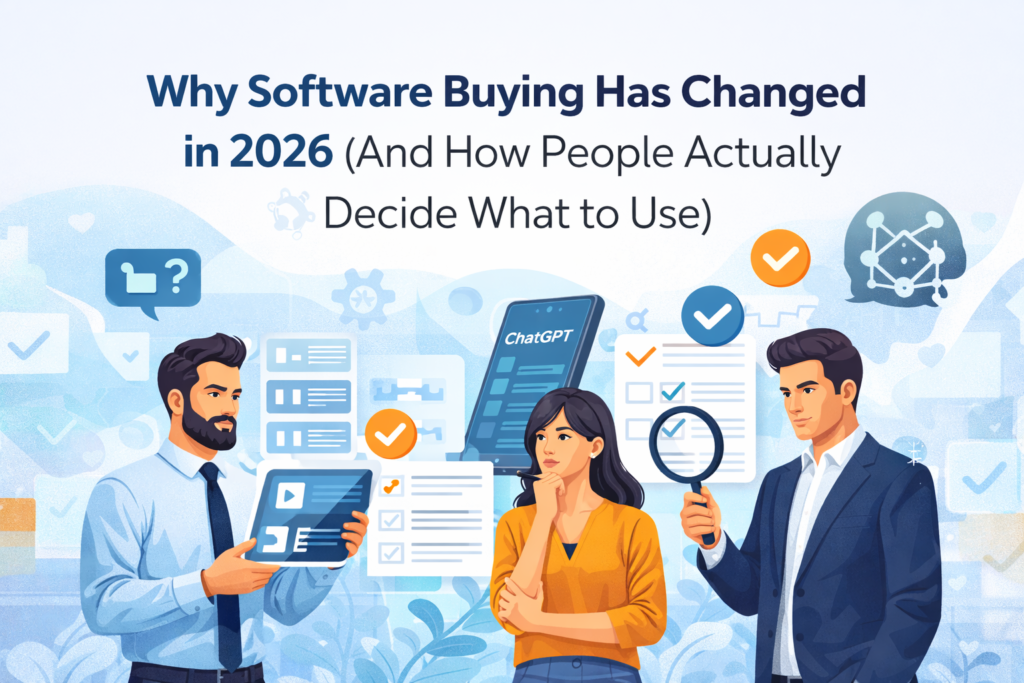
Software buying in 2026 looks nothing like it did even three years ago.
The old model was simple:
Search on Google → click the top result → skim a few “best software” lists → pick a tool with the most reviews.
That model is breaking down fast.
Today, buyers are overwhelmed by choices, skeptical of rankings, and increasingly turning to AI tools and structured research platforms to make decisions. Instead of asking “What ranks #1?”, they’re asking “What actually fits my problem?”
This shift has major implications for how software is discovered, evaluated, and trusted.
The Old Way: Ranking-Based Decisions
Traditional software discovery relied heavily on:
- Google rankings
- Domain authority
- Backlinks and affiliate-heavy comparison blogs
- Surface-level feature lists
These signals worked when:
- Fewer tools existed
- Categories were simpler
- Buyers had time to experiment
But in 2026, most categories are saturated. There are dozens of tools that look similar on paper, and ranking first doesn’t mean being the best fit.
Buyers know this — and they no longer trust rankings alone.
What Actually Changed in 2026
Three structural changes reshaped how people choose software.
1. AI Became the First Research Step
Instead of opening ten tabs, users now ask:
- “What software should I use for X?”
- “What’s the difference between these tools?”
- “Which option is safest for my business size?”
AI assistants don’t rank pages — they recommend answers. They rely on:
- Clear explanations
- Consistent mentions across credible sources
- Contextual relevance to the user’s intent
This means software discovery is shifting from visibility-based to understanding-based.
2. Buyers Care More About Fit Than Popularity
A tool being “popular” no longer guarantees it’s suitable.
Buyers now evaluate:
- Whether a tool matches their use case
- How complex it is to implement
- If it scales with their team
- Whether it integrates with their existing stack
This pushes users toward category-driven exploration, not generic lists.
3. Trust Signals Matter More Than Ever
With AI-generated content everywhere, buyers are cautious.
They look for:
- Clear positioning (what the tool does and doesn’t do)
- Transparency around capabilities
- Evidence the tool belongs in a specific category
- Neutral, comparison-friendly information
Platforms that organize software by purpose and context are becoming more valuable than promotional content.
How People Actually Decide What Software to Use Today
In 2026, the decision process usually looks like this:
Step 1: Define the Problem
Users start with a business problem, not a product name.
Examples:
- “We need better visibility into team performance”
- “Our customer support doesn’t scale”
- “We need to automate repetitive workflows”
Step 2: Identify the Right Category
Instead of searching for one brand, buyers explore a software category that addresses their problem.
This is where structured directories like Blankx play a critical role — helping users understand what type of software solves which type of problem.
Step 3: Shortlist Based on Context
From a category, users narrow options based on:
- Company size
- Industry
- Technical complexity
- Integration needs
They’re not looking for “the best tool for everyone” — they’re looking for the right tool for them.
Step 4: Validate Credibility
Only after shortlisting do buyers check:
- Product depth
- Vendor reputation
- Real-world usage
- Long-term viability
By this stage, rankings matter far less than clarity and relevance.
Why Category-Based Discovery Works Better Than Rankings
Categories help users:
- Understand the software landscape
- Compare similar tools fairly
- Avoid irrelevant or overbuilt solutions
- Make confident, informed decisions
This aligns with how both AI assistants and Google Discover now surface content — based on topic-level expertise, not site-wide authority.
A platform that consistently covers a category well builds trust over time.
Where Blankx Fits in This New Buying Journey
Blankx is built around how software discovery actually works today.
Instead of pushing users toward:
- Sponsored rankings
- One-size-fits-all “best” lists
Blankx focuses on:
- Clear software categorization
- Context-driven discovery
- Helping users explore tools based on intent, not hype
For buyers, this means less noise and better decisions.
For software vendors, it means being discovered for the right reasons, in the right category.
The Future of Software Discovery
Software buying will continue to move toward:
- AI-assisted research
- Intent-based discovery
- Category-level expertise
- Trust over traffic
Platforms that prioritize clarity, depth, and structure will win — not those chasing clicks.
The goal in 2026 isn’t to rank everywhere.
It’s to be understood in the right place.
And that’s exactly how modern software decisions are made.
Comments